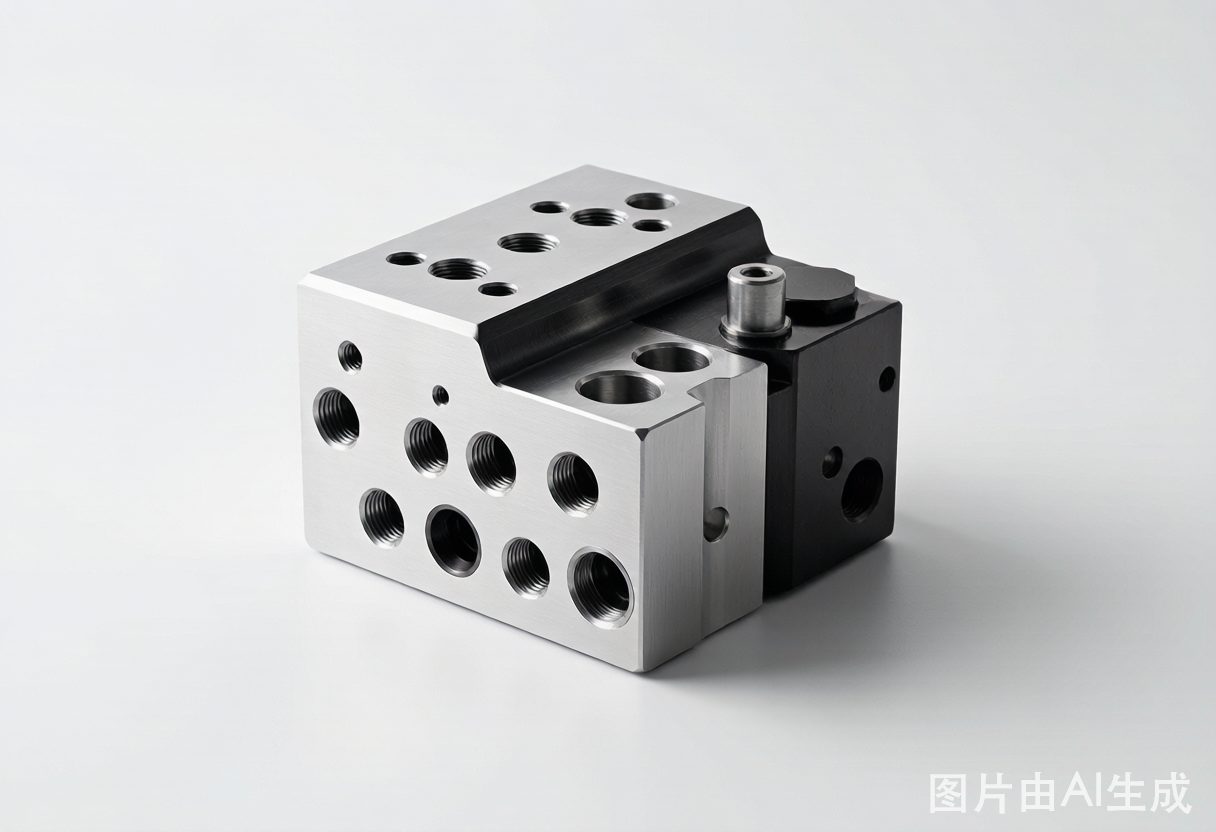
TL;DR: A Bosch Rexroth valve block alternative is a custom-machined hydraulic manifold — a hydraulic integrated circuit, or HIC — built to replace an OEM block by matching the valve mounting pattern, cartridge cavity standards, port threads and positions, rated flow paths and internal circuit function, so it drops into the same position with the same valves, hoses and connectors. Buyers switch when lead times stretch, a series is discontinued, prices rise, or the machine needs a function the catalog block never offered. HCIC CNC-machines replacement and custom manifolds to your drawing, sample or schematic — quoted within 48 hours, minimum order one piece, pressure-tested and shipped clean.
Bosch Rexroth valve blocks are standard equipment across agricultural machinery: harvesters, loaders, tractors and sprayers. They are well engineered — which is why they are everywhere, and why a sourcing problem appears when one fails. The good news: manifolds cross-reference more cleanly than cylinders. The caution: the circuit inside the block is not standardized, and the circuit is what the machine feels.
Why buyers replace a Rexroth block
- Lead time: a machine is down in season; the OEM channel quotes weeks.
- Price: captive spare-parts pricing on a machined body with standard cavities.
- Discontinuation: older series drop out of the catalog while machines stay in service for a decade.
- Function: the machine has been modified, or needs a function the original never had.
The fourth reason turns a replacement into an upgrade: once you machine a block anyway, a relief, check or flow control inside often costs less than the hoses it removes.
Why manifolds cross-reference differently from cylinders
A cylinder's mounting interface is effectively per-machine, which is why no supplier publishes a cylinder cross-reference table. A manifold is different — three of its interfaces are governed by published standards:
- Valve mounting pattern: ISO 4401 sizes such as NG6 and NG10 (CETOP heritage), with NFPA D03 and D05 as North American equivalents.
- Cartridge cavity: ISO 7368 (formerly DIN 24342) for slip-in valves, ISO 7789 or the corresponding SAE standard for screw-in cartridges.
- Port thread: ISO 6149 metric, SAE J1926 O-ring boss, or BSPP (ISO 1179 / ISO 228) on older machines; higher flows use ISO 6162-1 / 6162-2 flanges (SAE J518 Code 61 / 62).
So replacement is a structured question, but not an automatic one: port positions, internal flow paths and the functional schematic remain per-machine decisions, and they are where a cheap copy fails.
The seven checks before a replacement is quoted
The first three make replacement possible; the last four make it correct.
| Check | Why it matters |
|---|---|
| Mounting interface and port positions | CETOP or NFPA pattern sets whether valves bolt on, but port positions decide whether existing hoses reach |
| Cartridge cavity standard | ISO 7368, ISO 7789 or SAE cavities must match the valves being reused — the wrong cavity cannot be adapted |
| Rated flow and pressure drop | Drillings sized below circuit flow turn the block into a heater and slow the actuator |
| Internal circuit function | Reliefs, checks, load-holding and regeneration paths must match section by section — where copied blocks fail |
| Leakage and cleanliness | Internal leakage shows up as drift and heat; the block must ship clean and pressure-tested to a stated ISO 4406 code |
| Solenoid voltage and connector form | 12 V or 24 V coils and DIN or Deutsch connectors must match the machine harness |
| Material and surface treatment | Body material and corrosion protection suited to outdoor storage, fertilizer dust and pressure washing |
Send the OEM part number, photographs of the block faces, the schematic if you have it, and the coil data. Without one, we can reconstruct the circuit from the sample block.
Where replacement sensitivity is highest in agriculture
Not every circuit punishes a mismatch equally — this is where an error costs most.
| Application | What the block does | Replacement sensitivity |
|---|---|---|
| Harvester header lift and reel | Fast response, float and counterbalance functions | Critical — wrong circuit logic changes header response and can damage the frame |
| Load-sensing implement lift | Interfaces with the pump compensator and hitch control | Critical — signals must match the control architecture, not just the plumbing |
| Loader boom and telehandler | Multi-section control with load-holding checks | High — load-holding is safety-relevant and must be verified by test |
| Steering circuit | Priority flow, safety-rated function | Highest — no substitution without full circuit verification and documented testing |
| Sprayer boom fold and fan drive | Sequencing plus motor speed control | Moderate — sequencing logic matters, pressures are usually lower |
| Implement remotes and motor circuits | Simple directional control, sometimes flow sharing | Moderate — cavity and port matching usually decide the outcome |
If the block carries a safety function — steering, load-holding — the replacement must be verified against the full circuit, not just the old body.
What HCIC builds
HCIC machines hydraulic valve blocks and manifolds on CNC equipment, from customer drawings, a sample block, or a schematic our engineers turn into a machined design. Directional, pressure and flow control can be integrated into a single body, removing hoses, fittings and leak points — the argument set out in the benefits of integrated valve blocks. For blank-sheet projects, custom manifold design walks through how the circuit becomes drillings, cavities and port faces; the same team quotes directional and sectional valves in the same cycle.
Commercial terms and how to start
- Minimum order quantity: one piece — sample and trial orders are welcome, so a single-machine repair is never blocked.
- Payment: T/T, 30% deposit with order and 70% balance before shipment; sample orders are prepaid in full.
- Lead time: custom-machined manifolds typically 25–45 days from drawing approval; standard configurations ship faster, confirmed at quote.
- Response: every inquiry is quoted within 48 hours, including the approval drawing cycle.
HCIC's spare-parts program covers cylinders, valves and manifolds quoted by one engineering team, backed by Jinan Huachen Industrial Co., Ltd. (HCIC), founded in Jinan, Shandong in 1998, with three factories, 250+ employees including 20+ hydraulic engineers and about 95% of production exported. The group builds hydraulic cylinders and manifolds with bores from 40 to 630 mm, strokes to 12,000 mm and working pressures to 31.5 MPa, designed to ISO 6020 / 6022 / 10100, with a test report supplied with every order and an 18-month warranty. Manifolds are manufactured to customer drawings and destination-country requirements; CE marking is not applied.
Frequently asked questions
Can HCIC build a direct alternative to a Bosch Rexroth valve block?
Yes. HCIC CNC-machines replacement manifolds benchmarked against Bosch Rexroth hardware, matching the mounting pattern, port positions, cavity standards, flow path and circuit function, so the block drops in with the same valves, hoses and connectors. Send the part number, block photos, the schematic or the drawing, and we confirm the cross-reference in an approval drawing.
Which standards decide whether a manifold can be replaced?
Three families: the valve mounting interface (CETOP / ISO 4401 NG6 and NG10, or NFPA D03 and D05), the cartridge cavity standard (ISO 7368 slip-in, ISO 7789 or SAE screw-in), and the port thread (ISO 6149 metric, SAE or BSPP). Matching all three makes replacement possible; the schematic decides whether it is correct.
Do I have to reuse the original cartridge valves and solenoids?
Usually yes, and it is the cheapest route: the cavities then only have to match, not the valve performance. If the cartridges are being replaced too, send their part numbers, coil voltage and connector form. Either way the block ships clean and pressure-tested, and the system should be flushed to the target ISO 4406 code.
What are the commercial terms and lead time for a custom manifold?
Minimum order is one piece; sample and trial orders are welcome. Payment is T/T, 30% deposit and 70% balance before shipment; samples prepaid in full. Custom manifolds take 25–45 days from drawing approval; standard items ship faster, quoted within 48 hours. Every order ships with a test report and carries an 18-month warranty. Manufactured to customer drawings and destination-country requirements; CE marking is not applied.