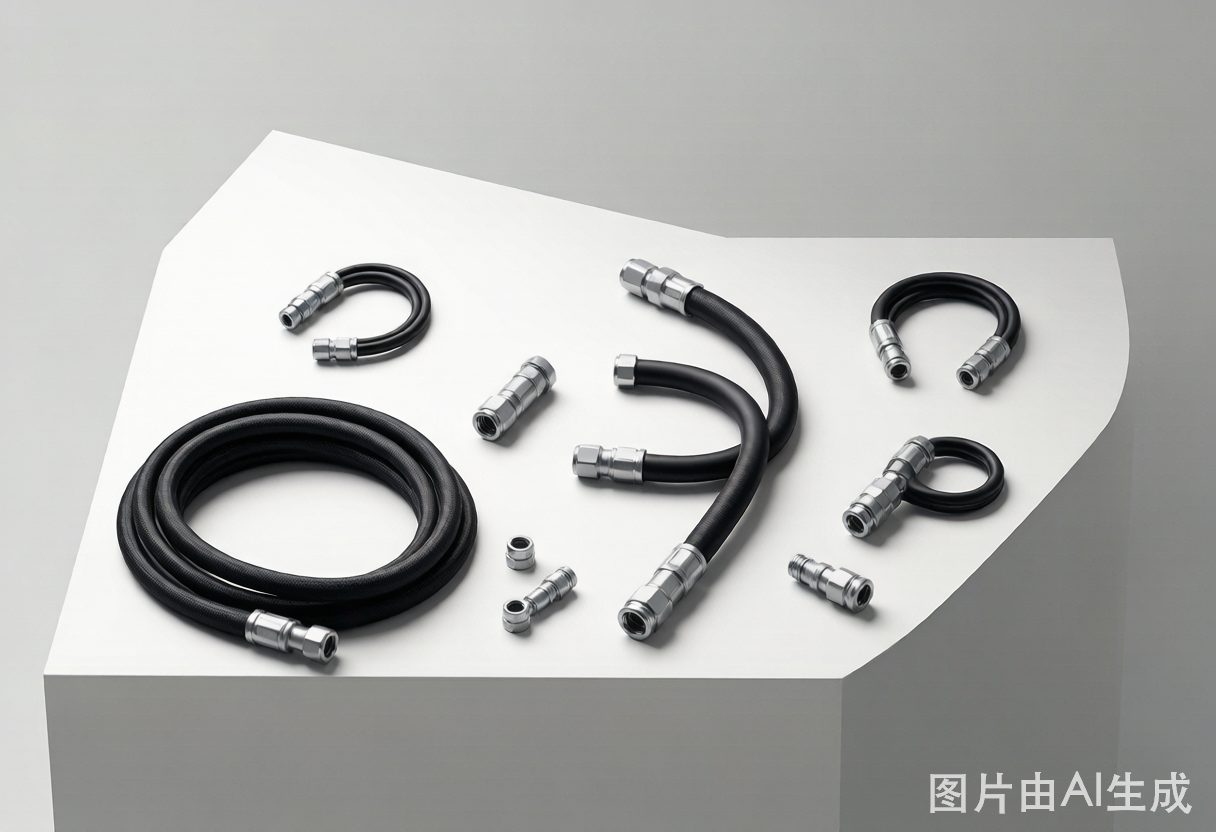
TL;DR: Most hydraulic hose bursts are not random. They come from abrasion, tight bends at the fitting, or a pressure spike the hose was never specced for. Read the split before you buy a replacement, because the same mistake re-installed will blow again in the same spot. This article walks through four failure patterns, how to spec the right line, and the cheap habits that keep a burst from happening twice.
A wheat farm in Saskatchewan sent me a photo last August: a hose off the front loader curl circuit had let go mid-lift, and the bucket dropped a half metre before the check valve caught it. The operator wanted a like-for-like replacement. The hose had 3,100 hours on it. The burst was at the ferrule.
He had changed the same line once already. That was the clue. When a hose fails twice in the same place, the hose is rarely the problem — the routing is.
Read the split before you order
A burst tells you what killed it. I keep a short mental table, and it saves a lot of rework.
| Failure pattern | What it means | Fix |
|---|---|---|
| Burst at the ferrule or fitting | Tight bend radius, or a bad crimp | Re-route with a longer hose or a 90° adapter |
| Pinhole worn in the cover, mid-line | Abrasion against a bracket or the boom | Add clamps, sleeving, or re-route |
| Clean split along the braid | Over-pressure or a pressure spike | Check relief setting and hose rating |
| Cover cracked and brittle | Heat, UV, or oil contamination | Shield from heat, spec a compatible cover |
The curl-circuit case
Back to that Saskatchewan loader. The curl cylinders mount close to the boom, and the hoses had been made to the original drawing length. On full curl, the line bent tight right at the port. Every lift cycle worked the wire braid back and forth at that one point.
We sent a replacement assembly with a forged 90° fitting and a slightly longer hose so the bend sat in a gentle loop instead of a kink. That loader is on its third season now without a repeat. The hose cost a few dollars more. The fix cost less than one lost afternoon.
Spec the hose to the spike, not the average
Manufacturers rate hoses by working pressure, but an implement sees spikes well above that. A loader that dead-heads against the relief valve, or a baler that stalls on a slug, will push the system to the relief setting in a heartbeat. If your relief is set at 2,900 psi, a hose rated for 3,000 psi working pressure is running with no margin.
Pick a hose whose working pressure is at least 25% above the relief setting. And match the fluid: hoses rated for mineral oil fall apart fast on some bio-hydraulic fluids, so check compatibility before you buy a roll. The pressure converter helps if your machine is plumbed in bar and the catalog is in psi.
Routing and clamping are half the job
Even a correctly specced hose will die early if it rubs. Route lines so they flex in one smooth plane, never twist, and never touch a moving part. Clamp long runs every 500–600 mm so vibration cannot saw the cover against a bracket.
Leave slack for the full travel of the cylinder or the folding boom. A hose that is tight at full extension is a hose that is already in tension. On anything that folds, watch the line at both ends of the stroke before you button the panel back on.
Where the whole system starts
Hoses only do their job if the rest of the circuit is right. An undersized line chokes flow and builds heat; a mis-specced directional valve spikes pressure on shift. I have seen more hoses killed by a sticky relief valve than by a genuine pressure overload.
When a machine eats hoses season after season, I stop replacing lines and start checking the valve and pump side. The pump and motor duty cycle, the relief setting, and the oil temperature all matter more than the hose grade.
How HCIC handles hose assemblies
HCIC has built agricultural hydraulics since 1998, from three plants and one R&D centre with 20+ engineers, running 210,000 units a year with 95% exported. Our hydraulic fittings, hoses and quick couplings are crimped in-house to your machine, with an 18-month warranty and a one-piece MOQ.
Send the dash size, working pressure, end fittings, and a photo of the old line — or the make and model of the tractor — and we match the assembly and the routing. If the real fault is upstream in the valve block, we will say so instead of selling you another hose. Quote within 48 hours.
Frequently asked questions
How do I tell what caused a hydraulic hose to burst?
Look at where the cover split. A burst at the fitting usually means the hose was bent too tight or the crimp was wrong. A pinhole in the middle is almost always abrasion wearing through the outer cover. A clean split along the wire braid points to over-pressure or a pressure spike.
Can I patch a burst hydraulic hose?
No. Hydraulic hoses run at hundreds to thousands of psi, and any splice or tape is a hazard. The only correct repair is a new hose assembly crimped to the right fitting, or a replacement line routed and clamped properly.
How often should agricultural hydraulic hoses be replaced?
There is no fixed hour count. Replace on condition: cracked outer cover, exposed wire, abrasion beyond 10% of cover depth, or a hose older than about six years in heavy seasonal service. Inspect every line during each service interval.
Can HCIC supply complete hose assemblies, not just hoses?
Yes. Our hydraulic fittings and hose assemblies are crimped in-house to match your tractor or implement, with a 48-hour quote and 18-month warranty. Send the dash size, working pressure, and end-fittings, or a photo of the old line.