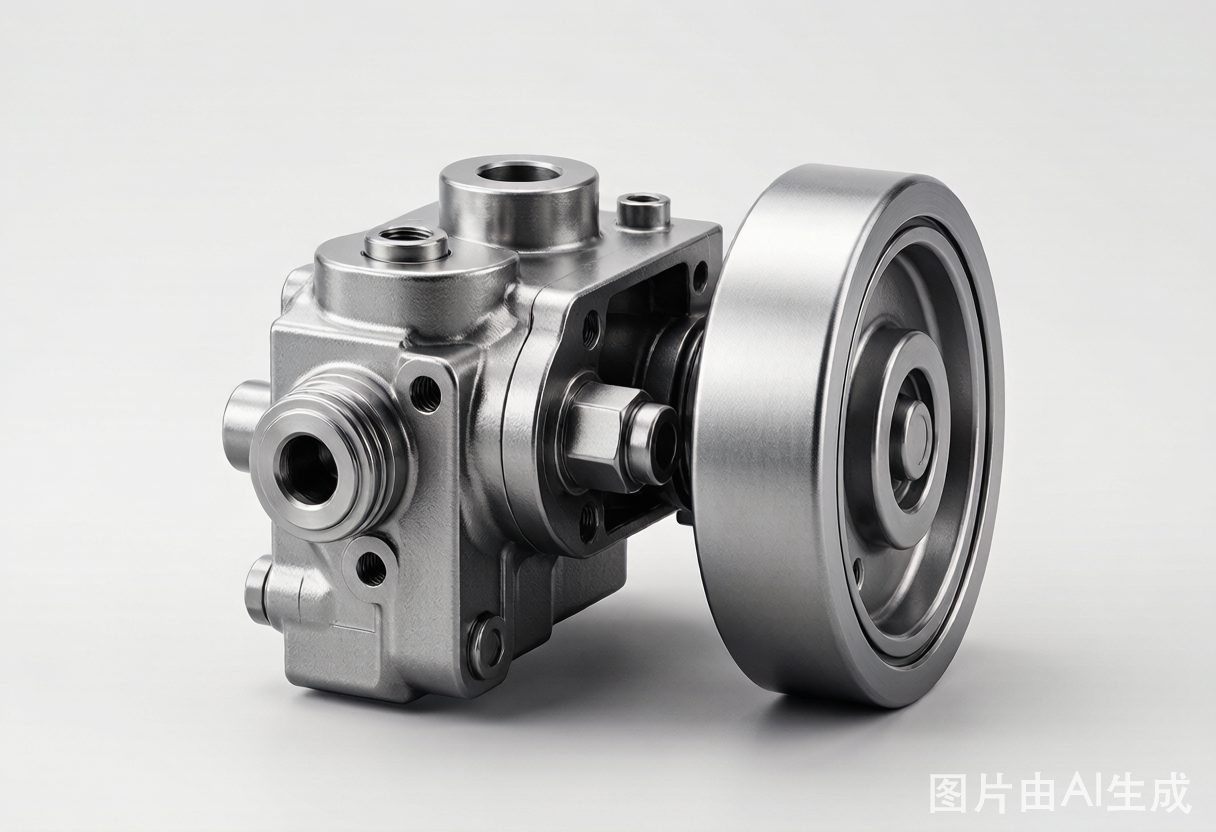
TL;DR: A PTO hydraulic pump is selected from the flow and pressure the implement needs at the actual pump shaft speed, not from the PTO label on the tractor. For a fixed-displacement pump, flow equals displacement times rpm times volumetric efficiency, about 0.90 on a new gear pump. A 20 gpm duty needs roughly 156 cm³/rev at 540 rpm, or 84 cm³/rev at 1000 rpm. Both move the same oil. They do not ask the same torque from the PTO.
Most pump enquiries start with "the spreader needs more flow, so I am going up a size." Sometimes that is right. Often the machine was never short of flow — it was short of inlet, or the pump was turning at a speed nobody checked.
A larger displacement raises theoretical flow at the same speed, and raises the torque the PTO must deliver by the same ratio. If the suction hose, valve and reservoir were sized around the old flow, the extra oil becomes heat instead of bucket speed.
Why the PTO label is the worst place to start
Two tractors with the same engine horsepower can have different PTO arrangements. A 540 rpm stub is normally 6-spline, 1-3/8 inch. A 1000 rpm stub is normally 21-spline at the same diameter, and 20-spline at 1-3/4 inch on higher-power tractors. Count the teeth first.
The duty shape matters as much as the flow number. A tipper wants high flow for under a minute. A spreader turns a conveyor motor for most of a shift. Calling all three "intermittent" hides the difference between a pump that runs cold and one that cooks its oil by mid-morning.
The displacement arithmetic that decides everything
Flow is the only thing the implement feels. For a fixed-displacement pump, theoretical flow equals displacement times shaft speed, and real delivery is lower because volumetric efficiency sits below 100 percent. Screening at 0.90 is fair for a new gear pump.
Run a 20 gpm target at both PTO speeds and the answers diverge. At 540 rpm the pump has to be large. At 1000 rpm it can be half the size for the same delivery.
| Target flow | Pump speed | Displacement at 0.90 vol. eff. | Hydraulic power at 2500 psi | Input power at 85% overall | Input torque |
|---|---|---|---|---|---|
| 20 gpm | 540 rpm | 156 cm³/rev (9.51 in³/rev) | 29.2 hp | 34.3 hp | ≈ 333 lb-ft |
| 20 gpm | 1000 rpm | 84 cm³/rev (5.13 in³/rev) | 29.2 hp | 34.3 hp | ≈ 180 lb-ft |
The power column does not move, and that is the point. Hydraulic power is flow times pressure, and neither changed. What changed is how that power arrives at the shaft: at 540 rpm it arrives as a large, slow torque; at 1000 rpm as a smaller, faster one. Torque is what breaks splines, couplings and torque arms.
Torque, splines and the part that actually breaks
Every PTO pump needs a torque arm anchoring the housing to the drawbar. Without one, the housing tries to rotate with the shaft: I have seen hoses wrapped around a spinning PTO in under fifteen seconds, and a pump body cracked at the mounting flange.
Listen for the coupling. A rattle that appears only when the relief opens means worn splines under shock load, and it will not fix itself. On a 1000 rpm driveline the same power passes at about half the torque, which is why high-power implements are specified that way — the spline interface is the weak link, not the pump.
Speed limits are not negotiable. A 540 rpm pump run at 1000 rpm delivers nearly double flow and doubles power demand, usually past what the inlet supports. A 1000 rpm pump on a 540 shaft delivers half the flow you planned for, and the operator concludes the pump is weak.
The suction line decides whether the pump lives
Cavitation is the quiet killer of gear pumps. When the inlet cannot keep up, pressure in the suction line falls toward vapour pressure, bubbles form, and they collapse against the gear faces and wear plates. The pump still turns. It just loses volumetric efficiency month by month until the implement slows and nobody can say why.
Keep suction velocity under about 1.2 m/s and use a hose rated for full vacuum rather than a length of return hose. A common layout for mid-flow tractor pumps is SAE 16 inlet and SAE 12 outlet; the inlet is larger precisely because suction lines need the area. Cold oil makes it worse — ISO VG 46 at 0 °C is thick enough that a pump can fail to prime at idle, and a minute of dry running scores a wear plate.
Heat is the other half of the duty cycle
Every horsepower that does not leave as hydraulic work becomes heat in the oil. In the 20 gpm example above, roughly 5 hp — about 3.7 kW — is released at full load. A reservoir sized for the old 12 gpm circuit will not absorb that, and temperature climbs until viscosity drops and internal leakage rises.
If oil reaches 80 °C within twenty minutes of continuous running, the circuit is undersized for that duty, whatever the nameplate says. Add cooler capacity, reduce continuous flow, or accept a lower duty rating.
Reading a pump data sheet without being fooled
- Rated pressure versus peak pressure. A 250 bar continuous rating with a 280 bar peak is not a 280 bar pump.
- Flow at rated speed. The gpm figure is tied to a shaft speed. Run slower and flow drops in proportion.
- Speed range. Minimum speed matters as much as maximum; too slow and the pump cannot hold its own inlet.
- Mounting and rotation. SAE A or B two-bolt flange, and clockwise or counter-clockwise rotation viewed from the shaft end, decided before the order is placed.
What to send when you ask for a quote
The fastest quote comes from a short, boring list: required flow in gpm or L/min, working pressure, and whether that flow is continuous or needed for seconds at a time. Add the PTO speed and spline count, pump rotation, mounting flange, and the port sizes you already have hoses for.
If a cylinder is in the circuit, send its bore, rod, stroke and retracted length too. Matching a pump to a cylinder that is already too small is an expensive way to learn flow was never the constraint. For tipping work, the cylinder side of the same calculation is on our sister site in the dump trailer telescopic cylinder guide.
How HCIC builds PTO-driven circuits
HCIC has manufactured agricultural hydraulics since 1998, from three plants and one R&D centre with 20+ engineers, producing 210,000 units a year with 95% exported. PTO work usually arrives as a matched set: a gear pump or motor, a sectional valve sized for the same flow, and the agricultural cylinders the circuit drives.
Every cylinder is pressure-tested at 3000 psi before it ships and built to your drawing under ISO 6020 / 6022 / 10100 practice. Quotes come back within 48 hours, samples start at one piece, and each unit carries an 18-month warranty with a full maintenance kit. Replacing a tired 12V unit on a small tipper instead? The single-acting versus double-acting power pack comparison covers that route.
Frequently asked questions
Should I choose a 540 rpm or a 1000 rpm PTO pump?
Choose by the flow you need and the torque your PTO can carry. At 540 rpm a 20 gpm duty needs about 156 cm³/rev; at 1000 rpm the same 20 gpm needs about 84 cm³/rev. The higher speed halves displacement and input torque, but only if the pump is rated for that speed and the inlet can keep up. If the tractor has only a 540 shaft, the decision is already made.
How much hydraulic flow can my tractor PTO actually drive?
Work backwards from power. Hydraulic horsepower equals flow in gpm multiplied by pressure in psi, divided by 1714. A 20 gpm pump at 2500 psi needs 29.2 hydraulic hp, and about 34 hp at the PTO at 85 percent overall efficiency. Use PTO power, not engine power — drivetrain losses of 15 to 20 percent are normal.
Why does my PTO pump run hot and noisy?
Usually the inlet is starving the pump. A suction line that is too small, too long or collapsing under vacuum causes cavitation, heard as a whine or rattle that worsens as the oil warms. Keep suction velocity low, use a full-vacuum hose, and confirm the pump speed matches the speed used in the displacement calculation.
Can HCIC supply the pump and the cylinders as one matched set?
Yes. Send the flow and pressure requirement, the PTO speed and spline type, pump rotation and mounting, plus cylinder bore, rod and stroke. We quote within 48 hours, accept sample orders from 1 piece, ship samples in 45-60 days and batches of 50 or more in 30-45 days, and cover every unit with an 18-month warranty and a full maintenance kit.