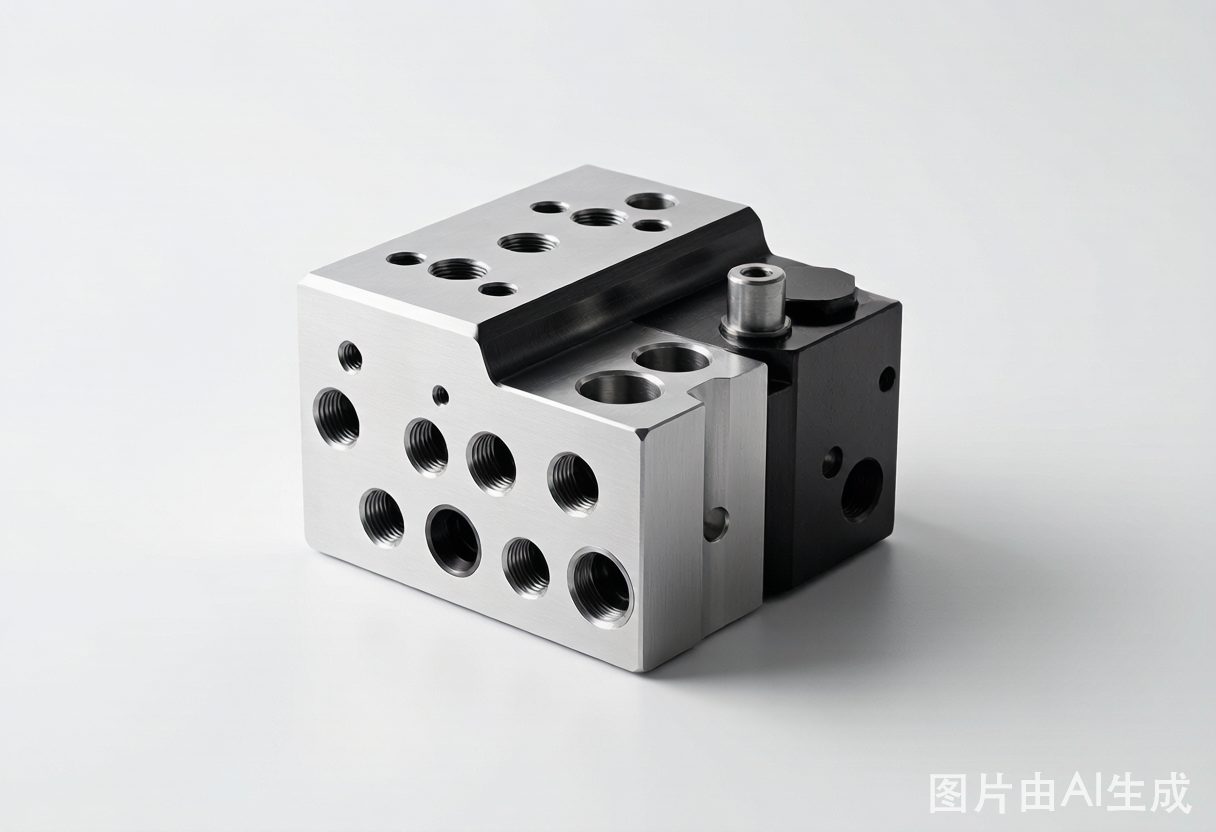
TL;DR: Precision agriculture succeeds or fails on repeatability — the same seed depth, the same boom height, the same application rate, pass after pass. That repeatability lives in the hydraulic system, and above all in the valve block. A manifold with load-sensing and flow-sharing keeps pressure and flow stable while implements and ground conditions vary. HCIC designs agricultural HICs and full hydraulic systems with exactly these controls, benchmarked against Danfoss Hydro-Line and Bosch Rexroth hardware, quoted within 48 hours.
Guidance systems get the headlines in precision agriculture, but GPS only steers the machine. When a planter dips, a boom bounces or a variable-rate controller calls for more flow mid-pass, it is the hydraulic circuit that decides whether the machine actually responds the same way it did on the last pass. Understanding where that stability comes from — and how to specify it — separates operations that get repeatable results from those that fight their equipment all season.
What precision agriculture demands from hydraulics
Three field requirements dominate. First, repeatable implement behaviour: a planter or seeder must enter the ground the same way every pass, which means consistent down-force cylinder response. Second, stable boom height for sprayers — a boom that wanders 100 mm between passes doubles your overlap or leaves skips. Third, simultaneous functions: steering, lift, fan motors and implement circuits all drawing flow at once, without any one of them starving the others.
All three come down to the same engineering problem: holding pressure and flow steady while the load changes. The component that solves it is not the pump or the cylinder — it is the control valve architecture between them.
Stability is engineered in the valve block
A hydraulic integrated circuit (HIC) — the manifold block integrating directional, pressure and flow control into one machined body — is where stability is created. The key features:
| Feature | What it does | Field benefit |
|---|---|---|
| Load sensing | Senses the highest load pressure and delivers only the flow each function needs | Implement response stays consistent across the full engine speed range |
| Flow sharing | Divides pump flow proportionally when demand exceeds supply | No function starves during simultaneous operations |
| Pressure compensation | Maintains set flow regardless of load pressure changes | Repeatable planter down-force and metering motor speed |
| Load-holding valves | Locks boom or implement position on failure | Safety and clean headland turns |
Our engineering article on load sensing versus flow sharing works through the mathematics of both strategies in mixed-load duty cycles — worth reading before your next manifold RFQ.
Why a manifold beats a nest of discrete valves
Older machines route functions through individual valves strung together with hoses. Every hose run is a potential leak, a pressure drop and a contamination trap — and each added function degrades the response of the others. An integrated manifold replaces most of that plumbing with drilled internal galleries:
- Fewer hoses and fittings — dramatically fewer leak points in dusty, high-vibration field conditions.
- Faster, more consistent response — internal galleries are shorter and stiffer than hose runs.
- Cleaner service access — a single tested block swaps out instead of tracing individual valves.
- Better contamination control — fewer dead volumes where particles settle.
HCIC builds these blocks as custom valve blocks and manifolds (HICs) — aluminum or ductile iron bodies, cartridge valves to standard cavities, pressure tests on every unit. For machines that stay on discrete architectures, we also supply directional and sectional valves matched to your existing circuit.
Specifying for OEM builds and retrofits
Whether you are an OEM designing a new sprayer platform or a fleet retrofitting a self-propelled sprayer, the specification conversation is the same. Bring the machine's flow demand table — each function, its flow, its pressure — and let the manifold be designed around it, rather than fitting functions to a generic block. Where replacement rather than redesign is the goal, HCIC benchmarks against Danfoss Hydro-Line and Bosch Rexroth hardware so drop-in replacements match original cavities, flows and response curves.
Practical specification points:
- State each function's maximum flow and pressure, including fan and motor circuits, not just cylinders.
- Specify cartridge valve cavity standards so future valve replacements stay off-the-shelf.
- Match cylinder sizing to the control strategy — our guide to sizing a hydraulic cylinder covers the bore/stroke math.
- Plan filtration at the manifold inlet — clean oil is the single biggest driver of valve-block life.
Complete custom hydraulic systems — manifold, pumps and motors, fittings and hoses, and the cylinders themselves — can be supplied as one tested package for tractors, harvesters and loaders, so responsibility for system stability sits with one supplier.
Maintenance: keeping precision after the warranty
Load-sensing circuits are tolerant of abuse but not of dirt. The most common field failure we see is a load-sensing line blocked by contamination — the circuit reverts to fixed displacement behaviour and implements start responding unevenly. A quarterly oil sample and filter change costs less than one lost seeding day. When a block does fail, HCIC's low-MOQ spare-parts program means a single replacement manifold or cartridge ships without batch-order friction, and every inquiry receives a quote within 48 hours.
Frequently asked questions
What is the difference between load sensing and flow sharing?
Load sensing matches pump output to the highest-load function's needs; flow sharing guarantees every function a proportional share when total demand exceeds pump supply. They work together — load sensing sets the pressure target, flow sharing divides the flow. See our detailed comparison in the article on load sensing versus flow sharing.
Can you retrofit a manifold into an existing machine?
Yes. Send the circuit diagram and hose routing, or photos and dimensions of the current valve arrangement. HCIC designs a drop-in manifold matched to your existing pump, cylinders and control levers — most retrofits reuse the machine's original cylinders and pump.
Do you match Danfoss or Bosch Rexroth cavities?
Yes. Replacement cartridge valves and manifold blocks are machined to standard cavities and benchmarked against Danfoss Hydro-Line and Bosch Rexroth hardware, so future valve replacements stay off-the-shelf regardless of supplier.
What is the lead time for a custom manifold?
Typically 20–35 days for a custom block from your flow demand table, including approval drawings. Standard replacement items ship faster. Every inquiry receives a quotation within 48 hours through the contact page.