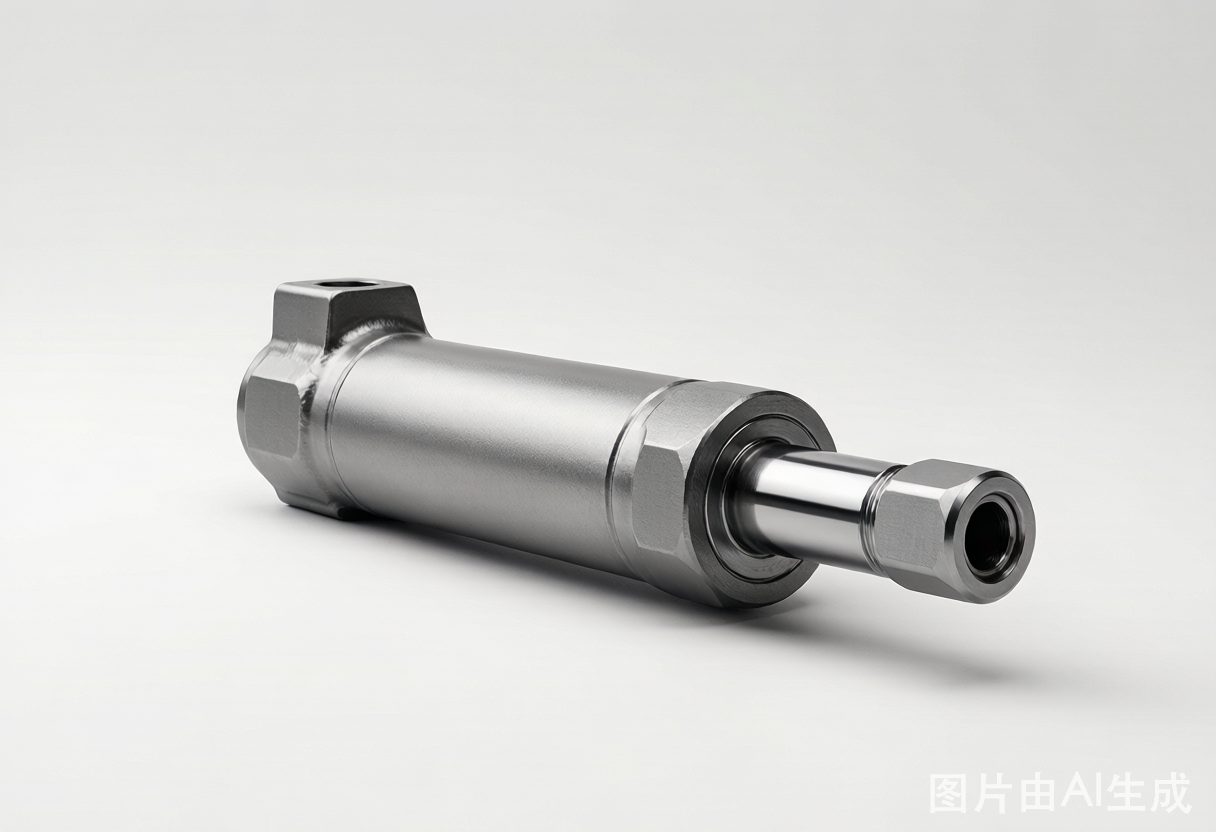
TL;DR: A bent front loader cylinder rod is column buckling, not a sign that system pressure was too high. The rod is a slender strut between two pins; an external force — back-dragging with the bucket curled down, or a lever multiplying a bucket-tip load — pushes it off axis and it bows long before the pump reaches relief setting. A relief valve caps pump pressure, not the mechanical load returning through the rod. I check geometry first: rod diameter, unsupported length, mount style and alignment. A stop tube, a larger rod or a linkage change fixes it.
In November 2021 a TractorByNet member opened a thread called "Cheap FEL cylinders keep bending" after a compact loader folded both curl cylinders. One poster, lpakiz, put the mechanics plainly: "a hydraulic cylinder simply pushes 2 pins apart or pulls those 2 pins together, nothing more. If the cylinder rod buckles, it's a sign that the rod is longer than its diameter supports." Another, LD1, argued that excess pump pressure was not the culprit: "when an outside force acts upon the cylinder... like back dragging with the loader curled down... you could easily see pressure spikes in excess of 5000 psi." That is a public, dated forum discussion, not a customer case. It still describes the failure we get asked about.
The rod is a column, not a pressure vessel
Hydraulic force acts on the piston area. The rod carries it as a compression member between two pin joints. At mid-stroke the piston and the gland bushing sit close together, so the unsupported length is short. Extend the rod and those bearing points move apart; it gets longer, more slender, and far easier to buckle.
That is why bent rods almost always fail near full extension. An OEM cylinder engineering guide states the trigger plainly: "When stroke length exceeds 10 times the rod diameter (L > 10d), compressive column buckling must be evaluated", with a 20 to 30 percent margin above calculated static forces. Stroke and rod diameter are the two numbers I want before quoting.
Why the relief valve never sees this load
The most common question I get is why the relief valve did not save the cylinder. A relief valve opens when pump pressure reaches its setting and dumps flow back to tank. It protects the pump, the hoses and the cylinder from hydraulic overload. It has no authority over a mechanical load arriving through the machine frame.
Back-dragging is exactly that load. The tractor pulls, the cutting edge digs in, and the ground pushes back through the bucket and linkage into the rod. The pressure spike is a symptom, not the cause; by the time a gauge sees it, the rod has passed its column limit. A healthy hydraulic valve block and a bent rod regularly show up on the same machine. The Peninsular Cylinder note on preventing side loading puts it bluntly: "No other method discussed here can take the place of proper, precise alignment during installation."
Where the force actually comes from
Loader geometry multiplies force. In that 2021 thread a member assumed 24 inches from bucket tip to pivot and 4 inches from rod to pivot — a 6:1 ratio — so a 1000 lb tip load becomes roughly 6000 lb of compression in the rod. Those are forum estimates, not test data, and I do not design to them. The ratio is the lesson: a longer bucket or a quick-attach plate that moves the pin centre outward raises compressive load without raising system pressure by a single psi.
Mounting geometry is the second multiplier. Ptsg named the shortcut in that thread: "The issue is when the manufacturers decide to increase the rod length without increasing the rod diameter." Longer reach on the same rod gains travel cheaply. I ask what implement was fitted and whether the linkage changed.
| What I see on the failed rod | Dominant load | Why the relief valve misses it | First check |
|---|---|---|---|
| Smooth bow, polish on one side | Side load plus compression | Load enters through the frame | Alignment and worn pivot pins |
| Sharp buckle near full extension | Axial column overload | Spike follows the rod yielding | Stroke-to-rod ratio, stop tube |
| Bend after a bucket or linkage change | Longer lever arm | Same pressure, more advantage | Pin centres and bucket length |
| Repeat failure on a replacement | Uncorrected geometry | New rod inherits the same load | Full measurement list first |
Side loading is a geometry problem
Once the load is off the rod axis, the fix is mechanical. The Peninsular note is specific: "head-style mounts provide superior column strength to cap-end mounts because the mounting points are closer together", and "A stop tube adds to buckling resistance and increases the distance between the piston and the rod bushing." A stop tube is an internal spacer keeping the piston away from the gland at full extension. It widens the bearing span; it does not centre the load.
Trunnion and clevis mounts let the cylinder articulate with a side load. Larger rods help because column stiffness scales with the fourth power of diameter, but they add weight and cost. The same guide adds a long-stroke rule: "If calculated push force exceeds K_k / 3.5, increase rod diameter or add stop tubes" wherever radial side loads are present. Neither replaces alignment at both ends of travel.
What I measure before quoting a replacement
A bent rod is scrap. Straightening it leaves out-of-round chrome that tears the new seal within weeks. Before we cut anything I want retracted and extended pin-to-pin lengths, stroke, rod diameter, both pin bores, mounting style and width, port threads, and the relief setting from the machine manual. Photos of both ends settle the thread standard. Our front loader cylinder replacement guide walks through that list; the bore arithmetic is in how to size a hydraulic cylinder. Where the panel loses position between cycles instead of folding, see our front loader cylinder drift guide.
How HCIC builds against it
HCIC has manufactured agricultural hydraulics since 1998, from three plants and one R&D centre with more than 250 staff including 20-plus engineers, at 210,000 cylinders a year with 95 percent exported. On a loader job we build to the customer drawing under ISO 6020 / 6022 / 10100 practice, pressure-test every unit at 3000 psi before dispatch, and supply an 18-month warranty after delivery with a full maintenance kit. We build to your drawing and to the requirements of the destination market.
The rod, the valve and the mounting are one decision. Our agricultural hydraulic cylinders, directional and sectional valves and pumps and motors are specified as a circuit, so relief setting and rod diameter are chosen together; loader notes sit under front loaders and telehandlers. Long-stroke telescopic rods fail by the same column logic, documented at telescopic cylinder rod scoring and bend, and refuse-side side-load failures at hooklift cylinder side-load failure. The public discussion behind this note is the November 2021 TractorByNet thread.
Where a number cannot be confirmed — a worn pin bore, an unreadable thread — we say contact us and confirm it on a dimensioned drawing before cutting. Quotations return within 48 hours, minimum order is one sample, sample lead time is 45-60 days after quote confirmation, and batches of 50 pieces or more run 30-45 days. Write to davidsong@mail.huachen.cc or call +8615376198599.
Frequently asked questions
Can a relief valve stop a loader cylinder rod from bending?
No. A relief valve caps pump pressure. The load that buckles a rod usually arrives from outside the circuit: back-dragging with the bucket curled down, a side impact, or a lever multiplying a bucket-tip load. By the time pressure spikes, the rod has passed its column limit. Port reliefs and counterbalance valves protect circuits, not rod slenderness.
Is a bent rod always caused by side loading?
No. Three mechanisms leave the same bent shape: axial column buckling under an external compressive load, a lateral impact adding a bending moment, and a rod undersized for its stroke. Bend direction, chrome wear and the position in stroke at failure tell them apart. We ask for photos of both mounting ends first.
What should I measure before ordering a replacement for a bent loader cylinder?
Measure retracted and extended pin-to-pin lengths, stroke, rod diameter, both pin bores, mounting style and width, port threads and the relief setting from the machine manual. Add photos of both ends and the port faces. Tell us which implement is fitted, because a longer bucket changes the lever arm. Mark any uncertain number; we confirm it on a dimensioned drawing.
What lead time and warranty does HCIC offer on replacement loader cylinders?
Samples ship in 45-60 days after quote confirmation, batches of 50 pieces or more in 30-45 days, subject to the confirmed quotation. Minimum order is one sample, quotations come back within 48 hours, every cylinder is pressure-tested before dispatch, and an 18-month warranty after delivery comes with a full maintenance kit.